
🌿 Plantain: The Medicine Growing Beneath Our Feet
Updated: 18 hours ago
There is something wonderfully rebellious about growing a plant that most people have spent their lives being told to kill - Plantain.
Not the banana-looking fruit — although every time I say plantain, someone inevitably thinks that's what I'm talking about. I'm talking about the humble little green plant that grows in lawns, along pathways, between cracks and across forgotten patches of earth. The one so many of us have walked over a thousand times without ever stopping to wonder what it was.
Plantain leaf (Plantago spp.) is one such wonder “weed” that’s found all over the globe. Two of the most common species, broadleaf plantain (P. major) and ribwort plantain (P. lanceolata), have followed human migration from Europe and Asia and are now naturalised in most temperate and subtropical regions of the world (CABI, 2020a; CABI, 2020b). Plantain is often considered invasive, and thrives in disturbed or compacted soils.
Right now, mine is going absolutely gangbusters here on the Sweet Earth Farm.
Every morning I walk past these beautiful green leaves knowing that now spring has sprung, they will soon bring another harvest. I much anticipated and exciting moment indeed.
Because once you begin learning about plants, something changes.
You stop seeing weeds.
You start seeing possibility.

The Plant We've Been Taught to Pull Out
Plantain belongs to the Plantago genus, and its relationship with humans stretches back centuries. Long before brightly coloured bottles filled our bathroom cupboards, people worked with what grew around them.
Plantain leaves were crushed, prepared, infused and incorporated into traditional remedies, particularly for the skin. And this isn't simply modern herbal romanticism.
Historical accounts of Plantago major describe its use for wounds across many parts of the world. The plant appears in herbal traditions spanning centuries, including descriptions from Dioscorides in the first century, medieval Scandinavian sources and later European herbals. Fascinatingly, the old Norwegian and Swedish name groblad essentially refers to a healing leaf.
Imagine that.
A plant we now mow over, poison or rip from our lawns was once familiar enough that generations knew exactly what it was and why they might want it nearby.
Perhaps the plant didn't become useless .... Perhaps we simply stopped learning its language.
A Little Green Medicine Chest
One of the things I adore about plantain is how unassuming she is. There are no spectacular flowers demanding your attention. No exotic appearance. No expensive marketing campaign convincing you she's special. She just grows. Quietly. Persistently. Generously.
Yet within those leaves is a beautiful collection of naturally occurring plant compounds. Research into Plantago major has identified iridoid glycosides including aucubin, along with flavonoids, phenolic compounds, terpenoids and polysaccharides. Modern research has identified compounds and investigated biological activities that help explain why this humble plant continues to attract scientific interest.
Much of that research remains laboratory-based, but the connection between traditional knowledge and contemporary investigation is fascinating — interesting scientific threads alongside its much older traditional use.

This meeting place between traditional knowledge and modern investigation, is no surprise to me. For me, these discoveries are a reminder that generations before us developed remarkable knowledge through observation, experience and their relationship with the natural world.
Somewhere along the way, we've become increasingly accustomed to looking towards commercially manufactured solutions, while overlooking the living pharmacy growing beyond our own doorsteps.
I believe there's room to question that dependence, and to have the choice to seek other alternatives.
Because herbalism isn't simply about memorising which herb is “good for” which condition. It is about understanding the plant. Its constituents. Its energetics. Its history. Its preparation. Its season. And its relationship with the body .... The plant is the lesson.
The Original Garden First-Aid Kit
Plantain has long been one of those plants herbalists have reached for when the skin needs a little care. Traditionally, fresh leaves have been crushed or bruised and applied externally. While dried leaves have been prepared in washes, infusions, oils and herbal teas, to draw out heat, calm gastrointestinal inflammation. Having both astringent and demulcent properties, plantain is also useful for helping to ease diarrhea
Another wonderful fact to this remarkable herb (not weed), the seeds and seed husks of plantain (specifically Plantago. ovata), are sold in commerce as psyllium, and are used as a source of soluble fiber to promote bowel regularity.

The seeds of Plantago.ovata, have an even higher content of mucilage, which is what creates the gel-like matrix that soothes the gastrointestinal lining. In effect, when we take plantain seed powder or plantain leaf tea to soothe and support wellness in the gastrointestinal tract, we’re still using them as topical vulneraries—we’re just using them to restore the lining of the gut—rather than the skin on the outside of the body!
This is something I find amazing!
No fancy packaging.
No complicated formulation.
And growing right under our feet .....
That's the part I think we've lost — not necessarily access to plants, because many of them are still growing all around us.
We've lost the knowledge of what we're looking at, and education gives us that back.
From “Weed” to Apothecary
This spring, leading into early summer, is exactly when I will begin to harvest her leaves, before her flowers begin —but if she is around when you need it, don’t hesitate to harvest the leaves at any time of year, even if it’s not peak season!
When making tincture, salve, oil, compresses, and other first-aid preparations from plantain it’s best to use clean, fresh leaves, which also makes a wonderful infusion. Dry plantain leaf is slightly less moistening but still very useful as an infusion. Here is our Sweet Earth field guide & herbal reference guide to help:

Now that you understand why plantain leaf is beneficial and how to harvest it, below is a super simple recipe that will make it easy to incorporate plantain into your herbal routine.
Plantain Leaf Green Juice
Adapted from The Wild Wisdom of Weeds by Katrina Blair (Blair, 2014) and featured in The Foraging Course.
Mineral-rich, this green juice is a fabulous way to start the day! No need to limit yourself to plantain—purslane (Portulaca oleracea), chickweed (Stellaria media), nettle (Urtica dioica), or other wild, edible leaves can be added or substituted in any combination. This recipe makes 2 servings.
Ingredients
2 cups fresh plantain (Plantago spp.) leaf
3 cups water
Directions
Place plantain leaf and water in a blender and blend on high for 1-2 minutes.
Strain out the juice and compost the fibrous plant material.
Enjoy as-is or on ice!

Fresh Plantain: The Simplicity of a Poultice
One of the oldest lessons in herbalism is also one of the simplest:
"Sometimes you don't need to turn a plant into a complicated product."
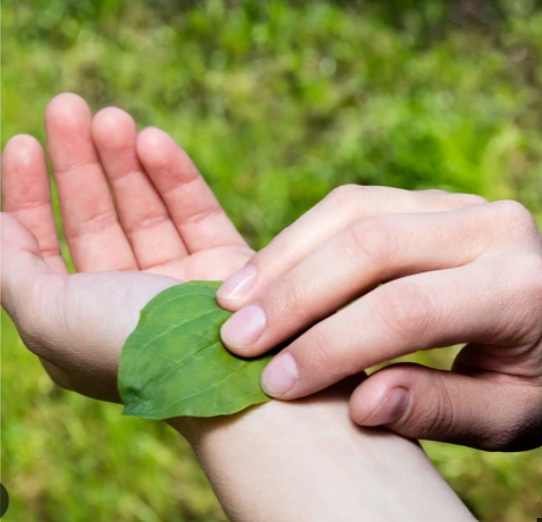
A traditional plantain poultice can be as uncomplicated as bruising or crushing clean fresh leaves to release their juices and applying the prepared plant material externally.
Whether you apply a freshly chewed (known as the field poultice), crushed in a mortar and pestle/blender, or have dried leaves/powder in your medicinal first aid kit, ready to apply.
Any way you prepare it, plantain is a premier wound-mending herb; it’s high in mucilage and a number of inflammation-modulating compounds (Adom et al., 2017), which give it a moistening, soothing, emollient quality.
It contains allantoin, a constituent that promotes tissue regeneration, which is also found in comfrey (Symphytum spp.)—but plantain is much milder and can be used to help resolve all types of minor superficial wounds without comfrey’s safety concerns.
Plantain has antimicrobial or antiseptic properties, and can help to stave off infection as wounds heal.
That's enough to make me stop and think about the true history of this great plant, and how liberating it is to empower yourself with the traditional knowledge, that enables us have the choice to heal through nature, and not just through commercial corporations.
Don't get me wrong, it isn't about rejecting everything modern.
It is about remembering enough that we still have choices.
The Weed That Followed Us
The genus name Plantago has been associated with the Latin planta, referring to the sole of the foot. Plantago major is extraordinarily good at growing in disturbed ground and places repeatedly travelled by humans.
There's something rather poetic about that.
Where humans walked...
plantain followed.
A medicinal plant beneath our feet, travelling alongside us while generations carried knowledge of how to use it.
And somewhere along the way, we were made to forget.
Yet plantain kept growing anyway.
Waiting for us to re-member with her again.
Before You Reach for the Weed Killer...
Learn what's growing there, that's it. I'm not suggesting everybody turn their backyard into a wild apothecary overnight or start eating unidentified plants because some crazy soap lady on the internet told you weeds are fabulous.
Learn first.
Identify properly.
Know your land.
Know what's been sprayed there.
Understand which part of a plant is traditionally used and how it is prepared.
Then decide what belongs in your life.
Because empowerment isn't blindly following somebody else's advice — including mine. Empowerment is knowledge.
It's being able to walk through your own garden and recognise some of the wild plants sharing that space with you....
It's knowing which ones feed pollinators.
Which ones nourish soil.....
Which ones have accompanied humans through generations.....
And which ones might deserve a place in your home apothecary rather than the green-waste bin.
Bringing Plantain Into Your Own World
You don't need a farm, you don't need an apothecary filled with a hundred jars and you certainly don't need to know everything before you begin.
Start with one plant.
Learn how to identify it confidently.
Learn its history.
Learn how people traditionally worked with it.
Learn when it grows in your area.
Watch it through its seasons.
Source the seeds and grow it if you can.
Harvest a little.
Dry some.
Perhaps make your first simple infused oil for your own salve.
Keep notes and begin growing your natural wisdom.
And most of all, pay attention. Build a relationship with the plant, rather than simply collecting another remedy.
That, to me, is herbalism.
And Here on the Sweet Earth Farm...
For now, I'm watching my plantain grow. Spring has breathed life back into the garden and those leaves are getting bigger by the day. Soon I'll head outside with my basket and begin harvesting.
Somewhere between the garden and the apothecary, ideas will become experiments. Experiments will become formulations. And perhaps, eventually, one of those formulations will find its way into the hands of the Sweet Family.
But I'm not rushing to decide what she needs to become.
For now, she gets to be plantain.
Growing in the earth.
Gathering sunshine.
Waiting for harvest.
And reminding me once again that some of the most extraordinary medicine doesn't arrive in fancy packaging ... Sometimes, it's been growing quietly beneath our feet all along.
From paddock to jar. From jar to skin. From ritual to remedy. That is the Sweet Earth way.
Love. Balance & Wholeness.
Stay Great-full. Stay Rooted.
Love All Ways.
Hala xo 🌿


Comments